
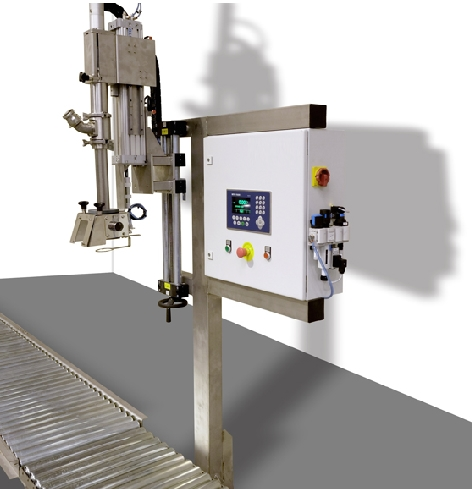
In industrial packaging, the final filling and sealing stage has a direct impact on product quality, transport safety, and customer confidence. A well-designed steel drum filling and sealing line does more than transfer liquid or semi-liquid material into a container. It helps manufacturers keep production organized, reduce waste, improve consistency, and prepare every drum for storage and shipment with greater confidence.
For companies that produce or pack oil, chemicals, lubricants, coatings, or bitumen products, a stable filling and sealing system is an important part of the whole drum production and packaging process. When the filling volume stays consistent and the sealing result remains reliable, the entire line becomes easier to manage. Operators spend less time correcting errors, the factory improves output, and the finished drums present a more professional image to customers.
Why Filling and Sealing Matter in Drum Packaging
A steel drum may look simple from the outside, but the packaging stage requires good coordination between product feeding, drum positioning, filling control, sealing, and output transfer. If one step lacks stability, the final result can suffer. Overfilling can increase material loss and create cleaning problems. Underfilling can affect product value and customer satisfaction. Poor sealing can create leakage risks during transport or storage.
That is why many manufacturers look for an automatic steel drum filling and sealing line instead of relying only on manual work. Automation helps create a smoother rhythm on the shop floor. It also supports repeatable production, especially when the factory handles large volumes or needs to package drums with the same standard every day.
Built for Different Products and Drum Types
A modern filling and sealing line can serve different packaging needs. Some customers need solutions for liquid products such as lubricating oil, solvents, or industrial chemicals. Others need equipment for higher-viscosity materials such as bitumen or specialty compounds. In these cases, the line design should match the product characteristics, production speed, and plant layout.
Steel drum filling systems can also be configured for different drum sizes and specifications, including common industrial formats such as 200L, 210L, and 220L drums. For some projects, the customer may focus on standard oil drums. For others, the goal may be bitumen barrel filling, chemical packaging, or a broader industrial drum solution. A flexible supplier should understand these differences and propose the right technical configuration instead of offering the same design for every application.
What Buyers Usually Look For
When customers choose a steel drum filling and sealing line, they often compare more than the machine price. They want to know whether the equipment can run steadily, whether operation is simple, and whether the line fits their product and factory conditions.
In many cases, buyers pay close attention to filling accuracy, sealing consistency, automation level, maintenance convenience, and safety design. They also want to understand how the line handles drum feeding, whether it supports conveyor integration, and how easily it connects with upstream or downstream equipment. If the factory plans to expand in the future, scalability becomes another important point.
A practical solution should help the customer not only start production, but also manage production more smoothly over time. That is why clear communication before manufacturing matters. A good equipment supplier should ask about product type, target output, drum specification, workshop space, and local power conditions before finalizing the machine design.
Benefits of an Automatic Filling and Sealing Line
An automatic system brings value in several ways. First, it improves production efficiency. When drum feeding, filling, and sealing work in sequence, the whole process becomes faster and more predictable.
Second, it supports cleaner production. Controlled filling helps reduce overflow and unnecessary loss of material. This is especially useful when the packaged product has high value or requires a cleaner working environment.
Third, it improves packaging consistency. Drums with a uniform filling level and reliable sealing quality are easier to stack, transport, and present to end users. This consistency strengthens the manufacturer’s professional image in the market.
Finally, an automatic line helps reduce dependence on heavy manual work. Instead of asking operators to manage repetitive tasks by hand, the system allows them to focus on monitoring, inspection, and process control.
A Complete Solution Creates More Value
Many customers prefer to source related equipment from one supplier because this approach simplifies communication and project coordination. If the filling and sealing line can connect with drum conveying, leak testing, palletizing, or other packaging processes, the project becomes easier to plan and execute.
For factories that also need drum body making, welding, testing, painting, or finishing equipment, working with one experienced machinery supplier can reduce interface problems between different machines. It also helps create a more unified production layout and a more efficient after-sales service process.
Choosing the Right Supplier
A filling and sealing line should not be treated as a generic product. The best solution depends on the customer’s real application. A reliable supplier should be willing to discuss the product type, output requirements, drum dimensions, sealing style, and site conditions in detail. The goal is not to sell a standard machine quickly. The goal is to deliver equipment that fits the project and supports long-term production.
For industrial packaging companies, investing in the right steel drum filling and sealing line means improving more than one process. It means creating a cleaner workflow, stronger packaging consistency, and better production efficiency across the factory.
If your business is looking for a practical solution for oil drums, chemical drums, or bitumen barrels, an automatic steel drum filling and sealing line can become a valuable part of your packaging system and help you build a more competitive production operation.